New Year’s Vision Boards That Actually Work (Because They’re Backed by Systems, Not Just Vibes)
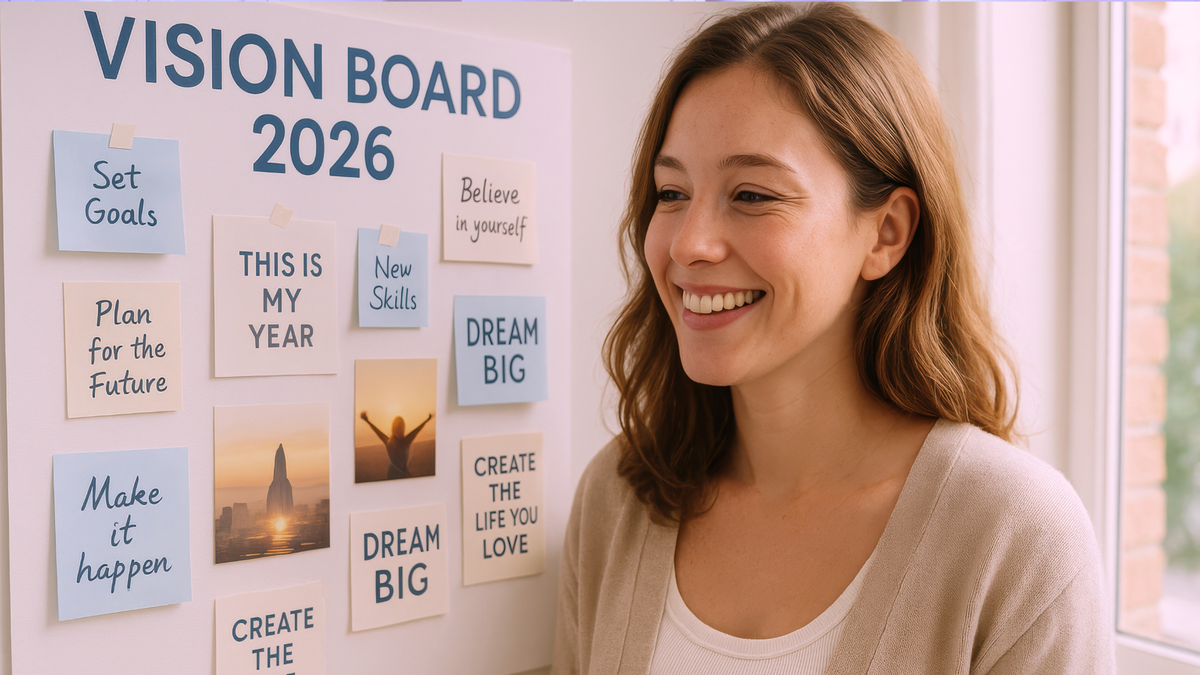
Vision boards are everywhere in December and January.
You cut out photos of your “dream life,” pin them to a board, prop it against a wall…and then, a few weeks later, you’re back in the same routines, with a pretty collage silently judging you from the corner.
It’s not that vision boards are useless. The problem is that most New Year’s vision boards stop at inspiration. They light up your imagination for a moment but never get translated into goals, habits, and systems your brain can follow.
If you want a vision board that actually changes your year, you don’t just need better pictures. You need a better process.
This guide gives you:
- A simple New Year’s vision board template
- A way to connect each image to clear goals and daily actions
- Ideas for using tools like Conqur to turn your board into a living system instead of wall art
Why Most Vision Boards Don’t Work
Let’s be blunt: most vision boards fail because they’re all “what” and no “how.”
Common problems:
- They’re vague.
Photos of beaches, fancy kitchens, and happy couples look inspiring—but they don’t tell you what to actually do on a Tuesday. - They’re passive.
You stare at the board and hope it “manifests.” The brain, however, needs clear cues and repeated actions, not just wishful imagery. - They’re disconnected from your calendar.
Your days fill up with email, errands, and obligations, and the board becomes background décor. - They ignore brain chemistry.
Motivation is fueled by small, frequent wins and visible progress. A static board doesn’t provide feedback, streaks, or that “I’m doing it” feeling. - There’s no system behind the pictures.
No goals, no habits, no tracking, no reviews. Just vibes.
So the core idea for 2026 is simple:
Vision without system = decoration.
Vision + system = direction.
Your board should inspire you, but your system should carry you.
A New Year’s Vision Board Template That Actually Works
Step 1: Choose 4–6 Life Areas (Not 20)
Start by picking a small set of areas that matter most for the year:
- Body & Health
- Money & Work
- Relationships & Family
- Mind & Emotional Well-being
- Personal Growth / Learning
- Fun & Adventure / Creativity
Don’t try to cram every possible desire into one board. Choose 4–6 areas that genuinely matter this year, not “someday.”
You can even write these as mini headings on your board or in your notes.
Step 2: Pick Images That Represent a Direction, Not Just an Outcome
For each area, choose 1–3 images that feel like:
- A direction you’re moving in
- A kind of day you want to live
- A way of being (calmer, stronger, more present), not just a single event
Examples:
- Body & Health: a person walking outside, cooking a simple meal, sleeping peacefully (not just a photoshopped six-pack)
- Money & Work: a calm workspace, a paid invoice, someone learning a new skill
- Relationships: a relaxed dinner with family, a walk with a friend
- Mind: journaling, meditation, nature
The key is that each picture should spark something like:
“This is how I want my actual days to feel.”
If you’re using Conqur, you can later use these same images as your goal image in Pictogoals, so your board and your digital system are visually aligned.
Step 3: Translate Each Image into One Clear Goal
Now, don’t stop at images. For each major picture on your vision board, write a short goal statement:
Use this template:
“In 2026, I am becoming someone who… [behavior]”
Examples:
- Health: “In 2026, I am becoming someone who moves my body most days.”
- Money: “I am becoming someone who saves consistently and spends intentionally.”
- Mind: “I am becoming someone who ends the day calm instead of fried.”
- Relationships: “I am becoming someone who makes time for meaningful connection each week.”
Then, make it concrete for Q1:
Q1 Target:
“By March 31, I will have… [specific things you can count]”
Example:
- “Walked at least 40 times.”
- “Saved $1,000 automatically.”
- “Done my 10-minute wind-down routine 60 nights.”
- “Had 10 intentional, device-free meals with family or friends.”
Write these Q1 targets under or behind the images, or in a notebook that “belongs” to your vision board.
Step 4: Break Goals into Tiny Daily/Weekly Actions
Here’s where your vision board turns into something your brain can work with.
For each goal, list 2–4 tiny actions:
- Body & Health
- 10–20 minute walk most days
- One simple “add” habit at meals (protein or veg)
- A consistent sleep window
- Money & Work
- Automatic weekly transfer to savings
- Weekly 10-minute money check-in
- One “learning” session per week (course, book, tutorial)
- Mind & Emotional Well-being
- 2–5 minutes of breathing or meditation
- Short nightly reflection: “one win, one gratitude”
- One “no” to something low-priority each week
- Relationships & Connection
- One meaningful conversation per week
- One meal or walk with phone away
- A quick “appreciation message” habit
These tiny actions are the bridge between your images and your actual days.
In Conqur, this is exactly where:
- Pictogoals hold the big picture and Q1 targets
- The Habit Tracker holds your tiny daily actions
- The Prioritizer pulls the most important next steps into each day
Step 5: Build a Simple System Around Your Board
Here’s the crucial part: your vision board is now input to a system, not the system itself.
Your system needs three components:
- A schedule / minimums
- When do these tiny actions fit into your week?
- Example: mornings = movement; evenings = reflection; Friday = money check-in.
- Tracking & feedback
- How will you see that you’re moving?
- Example: a habit app, Conqur streaks, or a calendar with checkmarks.
- Weekly review
- When will you look at what’s working and what needs a tweak?
- Example: 10–15 minutes on Sunday evening.
A simple weekly rhythm:
- Monday: look at your board for 30 seconds, then open Conqur (or your system) and see the Q1 tasks it translates into.
- Daily: do the minimum versions of your key habits; check them off.
- Sunday: look once at the board, then ask, “What did I do this week that’s moving me closer to this picture?”
Vision boards work when they’re the starting point of a loop:
image → goal → habit → tracking → review → renewed connection to the image.
Vision Boards + Conqur: Turning Images into Action
You can absolutely do all of this with paper and pen.
If you’re using Conqur, you can make your board and app work together:
- Step 1: Take a photo of your physical vision board, or crop individual images.
- Step 2: Create one Pictogoal for each major area (Health, Money, Mind, Relationships) and upload the corresponding image.
- Step 3: Add your Q1 target as the goal description.
- Step 4: Under each Pictogoal, create milestones like:
- “Walk 40 times”
- “Save $1,000”
- “50 evenings of wind-down time”
- Step 5: Turn your daily actions into habits or habits, and let Conqur’s streaks, focus timers, and breathing tools support you through the friction.
Now your New Year’s vision board isn’t just something pretty on the wall. It lives inside a system that:
- Reminds you what matters
- Shows you your progress
- Rewards consistency
- Helps you adjust when life gets messy
That’s how a board goes from “manifestation art” to a map you’re actually walking.
Quick Vision Board Template (You Can Paste This Into a Note)
You can include this as a box in the post:
NEW YEAR’S VISION BOARD TEMPLATE (SYSTEM-FIRST)
- Choose 4–6 Life Areas
- ☐ Body & Health
- ☐ Money & Work
- ☐ Relationships & Family
- ☐ Mind & Emotional Well-being
- ☐ Personal Growth / Learning
- ☐ Fun, Play & Adventure
- Pick 1–3 Images Per Area
- “What do I want my days to look and feel like?”
- Write a 2026 Identity Goal Under Each Area
- “In 2026, I am becoming someone who _________.”
- Set a Q1 Target (Jan–Mar)
- “By March 31, I will have _________ (something countable).”
- List Tiny Actions
- 2–4 daily/weekly actions per area (walk X, save Y, reflect, connect, etc.)
- Connect to a System
- Add goals + habits into Conqur (or your planner).
- Schedule a weekly review (15 minutes).
- Track streaks so you can see your progress.
The Bottom Line: Vision Boards Without Systems Are Just Posters
Vision boards are not magic. They won’t rewire your habits or rearrange your calendar on their own.
But they can be powerful when:
- They’re specific to this year, not your entire fantasy life
- Every image is connected to one clear goal and a Q1 target
- Those goals are broken into tiny, trackable actions
- You’ve built a simple weekly system to nudge them forward
That’s when your New Year’s vision board stops being a mood board, and starts becoming a quiet, visual contract with your future self.