Async Life: Productivity Strategies for People Who Never Get a Quiet Block of Time

If you are always waiting for a long, uninterrupted block of time before you begin, it can start to feel like your real life is constantly on hold. You tell yourself you will get to the important work later, when things calm down, when the house is quieter, when your inbox settles, when the kids are occupied, when the meetings stop, when your brain is less tired. But for a lot of adults, that clean block never really comes.
This is one reason so many people quietly struggle with productivity with no focus time. It is not that they do not care. It is not that they are disorganized or lazy. It is that their days are fragmented. They are trying to think, create, respond, remember, and move things forward in between interruptions, responsibilities, and tiny pockets of time that open and close without warning.
An async life requires a different kind of productivity. It asks you to stop building your whole system around ideal conditions and start building for the life you actually have. That does not mean giving up on meaningful work. It means learning how to get things done in small pockets of time without feeling like you are always behind or doing everything halfway.
Why traditional productivity advice often fails in real life
A lot of productivity advice assumes you have control over your time in a way many people simply do not. It assumes you can block off a beautiful ninety-minute focus session, turn off notifications, close your door, and work in peace. That may be realistic for some people some of the time. But for a lot of adults, especially caregivers, managers, founders, freelancers, people in client-facing roles, or anyone living in a reactive season, it is not a stable reality.
When your day is built around interruptions, the usual advice can make you feel worse instead of better. You start thinking you are failing because you cannot work in the “right” way. But the real issue is not your character. It is that your system is built for a type of day you rarely get.
This is where async work productivity tips become more useful than idealized focus advice. Async productivity is not about waiting for the perfect stretch of quiet. It is about making progress in a life where time arrives in fragments.
What an async life actually requires
An async life requires you to think in layers instead of blocks. Instead of assuming every meaningful task needs one long sitting, you learn to divide work into pieces that can survive interruption. You make it easier to stop and restart. You reduce the mental cost of context switching. You build a system where your future self can pick something back up without having to reconstruct the entire thought process from scratch.
This matters because one of the hardest parts of fragmented days is not the interruption itself. It is the re-entry. It is reopening something and spending ten minutes trying to remember where you were, what mattered, and what the next step is. That is what makes small pockets of time feel useless when they often are not.
The solution is not to force your life to look more controlled than it is. The solution is to make your work more restartable.
Stop waiting for a “real work session”
One of the biggest mindset shifts in an async life is letting go of the idea that only long, uninterrupted sessions count as real progress. That belief can quietly keep you stuck. You tell yourself there is no point in starting because you only have twelve minutes. Or twenty minutes. Or a half hour that might get interrupted anyway.
But meaningful work often moves through small increments when those increments are well chosen. The issue is not always the size of the time pocket. It is whether you know what to do with it.
If you only have ten minutes, that may not be enough for deep strategy work, but it may be enough to write the next paragraph, organize the next three tasks, send the needed message, outline the next section, review a draft, or make a decision that has been sitting in limbo. Small pockets of time are often wasted not because they are small, but because the next step is unclear.
Build “restartable” work instead of perfect work
If your days are broken up, one of the most useful things you can do is break your work into units that are easy to re-enter. That means making tasks smaller, more visible, and more concrete. “Work on project” is almost impossible to re-enter quickly. “Write opening paragraph,” “review slide three,” “send approval email,” or “brainstorm three title options” is much easier to pick back up.
This is one reason task clarity matters so much in productivity with no focus time. The more specific the task, the less energy you lose trying to remember what the task even means.
When a goal is large or multi-step, it helps to break it down before the day gets chaotic. If you like keeping bigger work visible in smaller pieces, Pictogoal can help turn a big project into a sequence of doable actions rather than one heavy item you keep avoiding.
Use “entry tasks” and “deep tasks” differently
Not every task belongs in the same time pocket. A helpful distinction is between entry tasks and deep tasks.
Entry tasks are tasks you can begin or complete in a short stretch without much setup. These are often ideal for fragmented time. They might include replying to a message, outlining ideas, cleaning up a document, confirming an appointment, drafting a short section, reviewing notes, or preparing materials for later.
Deep tasks require more cognitive immersion. They might include writing something substantial, problem-solving, strategy work, complex creative work, or anything that needs sustained attention.
The mistake many people make is trying to force deep tasks into tiny pockets with no ramp-up. That creates frustration. A better strategy is to use small pockets for entry tasks, preparation, and movement. Then, if you do get a rare longer stretch, you are ready to use it well because the setup work is already done.
Treat small pockets of time like stepping stones
When you live asynchronously, progress often happens through stepping stones rather than full leaps. One ten-minute pocket is used to define the next step. Another is used to gather materials. Another is used to draft the beginning. Another is used to revise. Over time, those fragments build something real.
This can feel less satisfying at first if you are used to thinking in “finish line” terms. But it is far more realistic for many seasons of life. It also reduces the emotional weight of starting because you are no longer demanding that one pocket of time do everything.
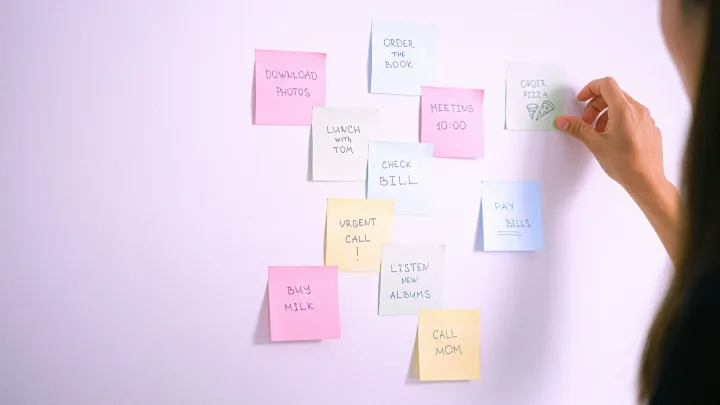
If you struggle to know what to do next in those fragments, keeping a short, visible list in your To-Do List can make a huge difference. Not a giant list. Just clear next actions that fit the kind of time you actually have.
Reduce the restart cost
In an interrupted life, one of your main goals is reducing restart friction. This means leaving breadcrumbs for yourself every time you stop. Before you leave a task, write the next move in plain language. One sentence is enough. “Next: summarize section two.” “Next: send revised draft to Sam.” “Next: pull three quotes from research notes.” That tiny note can save you from losing momentum later.
This is one of the most underrated async work productivity tips because it makes fragmented time more usable. You do not have to trust your memory. You do not have to rely on motivation. You just return to the breadcrumb.
The same principle works for recurring responsibilities too. If your life includes many moving parts, the more you can externalize, the less your brain has to hold open at once.
Create categories for different energy levels
Async life is not only about fragmented time. It is also often about fragmented energy. A ten-minute pocket when you feel clear is different from a ten-minute pocket when you feel mentally fried.
That is why it helps to have different kinds of tasks ready for different levels of energy. Some tasks require initiative and thought. Others just require light attention. If you know your energy is low, you can use a small pocket for lighter tasks instead of demanding high-level thinking from an exhausted brain.
This approach is more compassionate and more strategic. It stops you from wasting time arguing with reality. You are not choosing a lesser form of productivity. You are matching the task to the actual conditions.
If choosing what matters most feels hard in the middle of a chaotic day, Prioritizer can help narrow your next best steps so every time pocket does not begin with a stressful decision.
Protect whatever focus you do get
Even in an async life, there will sometimes be small stretches where your mind is clearer and your environment is quieter than usual. Those stretches matter. If you notice one opening, it helps to protect it quickly rather than wasting it on random checking and low-value admin.
This does not mean you need an elaborate ritual. It means that when you have a real opening, you already know what deserves that level of focus. You do not spend the first fifteen minutes deciding.
A short sprint can also help you use that window well. If you like defined containers for attention, the Mental Flow Timer can create a clear boundary for focused work without requiring a huge block of time. Sometimes twenty focused minutes in a chaotic day matters more than an hour you never get.
Build a daily “three moves” system
When time is fragmented, it helps to think in terms of key moves rather than perfect plans. A simple daily question is: what three moves would make today feel meaningfully used, even if the day gets messy? Those moves might not all be completed in one sitting. They may unfold across the day in pieces. But they give your attention somewhere to return.
This kind of structure is especially useful when you often end the day thinking, “I was busy all day, but what did I actually do?” Three clear moves reduce that fog. They also create a sense of completion that is less dependent on ideal circumstances.
Stop measuring your day by uninterrupted hours
One reason async life can feel demoralizing is that people often measure themselves against a model of productivity they are not currently living. They compare their fragmented day to someone else’s protected workday and conclude they are ineffective.
A better question is not, “How many uninterrupted hours did I have?” It is, “Did I use the reality of my day well?” That is a very different measure. It allows you to build confidence from actual progress instead of constantly failing an unrealistic standard.
This matters for self-worth as much as productivity. If you keep judging yourself by conditions you rarely have, you will always feel behind. If you start measuring by what was possible in your actual day, your relationship with work becomes steadier.
A realistic way to get things done in small pockets of time
If you are trying to figure out how to get things done in small pockets of time, the answer is not to squeeze harder. It is to simplify the decisions. Know your next actions. Break work into restartable pieces. Use short pockets for setup and progress rather than expecting full completion. Leave breadcrumbs when you stop. Protect whatever focus you do get. Keep your list short enough that your brain can still see it clearly.
And if your days feel mentally noisy before you even begin, a short reset can help. Even one minute of Box Breathing can calm the sense of mental scattering just enough to make a small pocket usable instead of wasted.
Progress in an async life still counts
An async life does not mean your work is less serious or your goals are less real. It just means your system has to be designed differently. Progress may look less cinematic. It may come in shorter bursts, more visible steps, more thoughtful handoffs between one moment and the next. But it still counts.
Some seasons of life will not give you long, quiet blocks on a regular basis. That does not mean you have to put your goals, your creativity, or your meaningful work on hold until life becomes simpler. It means you need a system that respects fragmentation without surrendering to it.
That is the heart of async productivity. Not perfect focus. Not ideal conditions. Just a smarter way to keep moving in the life you actually have.